Color Mastermind
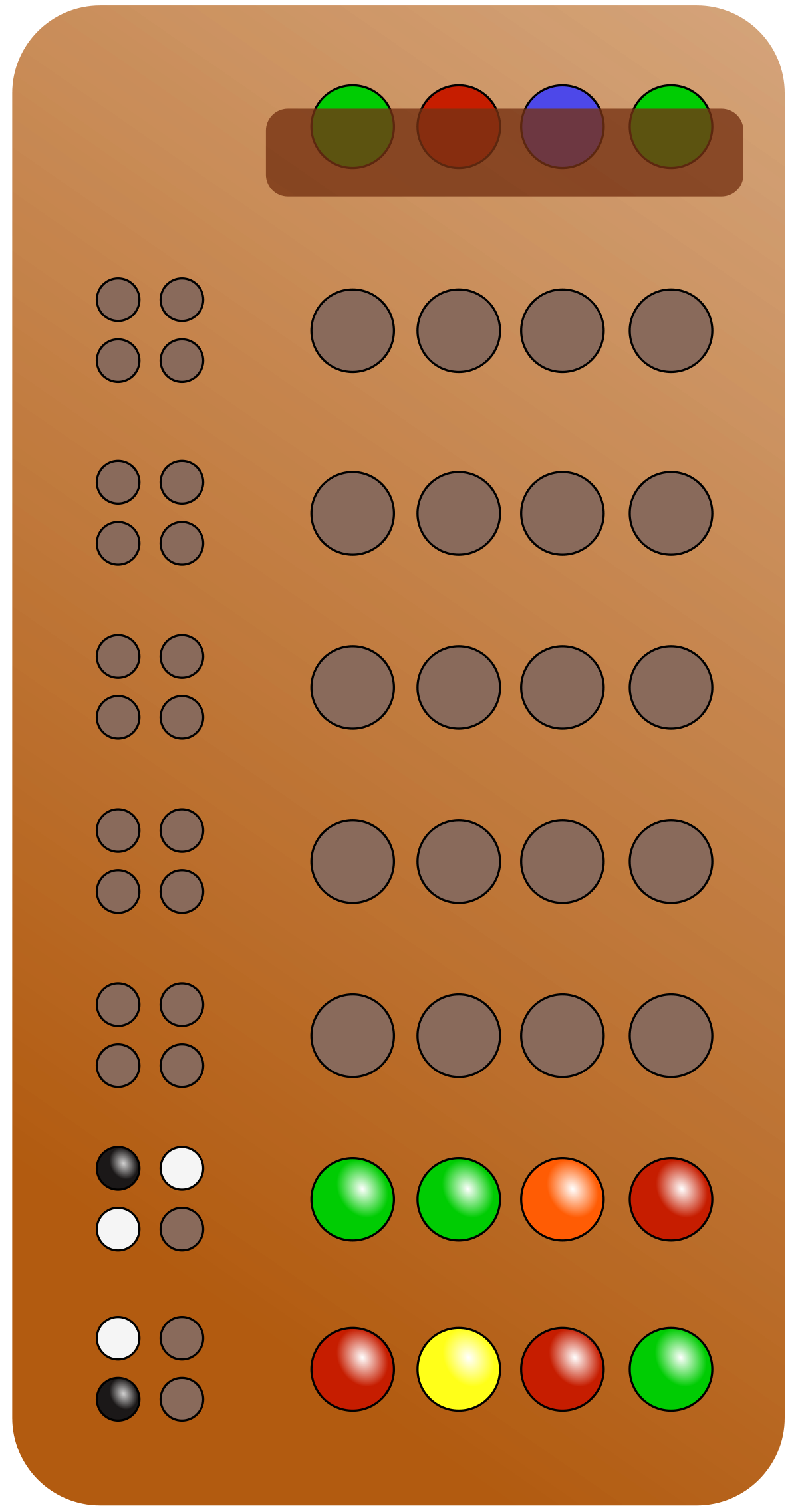
This game is the classical Mastermind game as 1 player version. The objective of the game is to guess the secret code, this is a sequence of N colors (strings) chosen from M colors available. Each turn the player has to guess the code. After each guess, the game will tell the player which of the guesses appears in the code but are not correctly positioned, and which ones are correctly positioned. The goal is to guess the code in the fewest number of turns.
Some changes have been made to the original game:
There is only one player (guesser) while the other player (password-maker) is not considered a player.
Colors are represented by strings.
There are 2 versions: with repetitions (same color could appear more than once in the code) and without repetitions.
An online version of the game can be found at this link.
Note
This game is very similar to Wordle <wordle_docs> game, with the difference that the feedback is not given per position but as a total of correct and misplaced values.
Goal
Guess the correct secret code in the fewest number of turns.
Score
The score is -T where T is the number of turns needed to guess the secret code.
The highest the score, the better.
Import
from IArena.games.ColorMastermind import ColorMastermindPosition
from IArena.games.ColorMastermind import ColorMastermindMovement
from IArena.games.ColorMastermind import ColorMastermindRules
Movement
A movement has a guess in the format of List[str].
It must have N strings.
guessList[str]len == NEach value is a string representing a color. The available colors are defined by the rules of the game.
# A guess in a game with N=3
movement = ColorMastermindMovement(guess=["red", "blue", "green"])
Warning
Depending on the rules, the guess could be invalid if has repeated values (the same number more than once).
Position
A position is represented by a list of movements (guesses) and a list of feedback.
Feedback
A ColorMastermindFeedback is an object that contains 2 integer values:
correct: the number of values in the guess that are correctly placed.misplaced: the number of values in the guess that are in the secret code but misplaced.
# position : ColorMastermindPosition
guesses = position.guesses()
feedback = position.feedback()

guesses[-1]  # Last guess
guesses[-1][0]  # First position of the last guess

correct = feedback[-1].correct  # Number of correct values in the last guess
misplaced = feedback[-1].misplaced  # Number of misplaced values in the last guess
Methods
guesses() -> List[ColorMastermindMovement]: List of guesses made so far.feedback() -> List[List[ColorMastermindFeedback]]: List of feedback lists made so far.last_guess() -> ColorMastermindMovement: Last guess made.last_feedback() -> List[ColorMastermindFeedback]: Feedback of the last guess.code_size() -> int: Number of values in the secret code (N).number_values() -> int: Number of different values available (M). If no repetitions allowed, M >= N.allow_repetition() -> bool: Whether the secret code can have repeated values.possible_colors() -> List[str]: List of possible colors available in the game (no repeated values).
Rules
This object defines the rules of the game, including the secret code. When constructed, it sets the secret code, the number of values in the code (N), and the number of different values available (M), and whether repetitions are allowed.
Within the rules, the value possible_colors_ is defined, which is a list of different strings representing the available strings in the game.
Each of the strings is meant to represent a different color.
However, no required format is imposed on the strings, so they can be any string values, as long as it is that each value belongs to the possible values given by possible_colors().
Methods
code_size() -> int: Number of values in the secret code (N).number_values() -> int: Number of different values available (M). If no repetitions allowed, M >= N.allow_repetition() -> bool: Whether the secret code can have repeated values.possible_colors() -> List[str]: List of possible colors available in the game.
Constructor
Arguments for constructor are:
code_size: int: Nnumber_values: int: Mpossible_colors: List[str]: List of M different strings representing the possible colors.secret: List[str]: List of N values inpossible_colorsrepresenting the secret code.allow_repetition: bool: Whether the secret code can have repeated values.
Using a secret code already defined.
# Secret code with N=4 and M=6
rules = ColorMastermindRules(
    code_size=4,
    number_values=6,
    possible_colors={"a", "b", "c", "d", "e", "f"},
    secret=["a", "b", "c", "d"],
    allow_repetition=False
)
Default Colors
There is a function ColorMastermindRules.default_colors(number_values: int) -> List[str] that returns a list of default colors (strings) for a given M.
from IArena.games.ColorMastermind import ColorMastermindRules

colors = ColorMastermindRules.default_colors(6)
print(colors)  # Output: {'red', 'blue', 'green', 'yellow', 'orange', 'purple'}